Every client remembered. Every reason to be in touch, on time.

Stitchwork keeps one record of each client — what they love, what they own, what they looked at online, who looks after them — and gives your team a short list each morning of who to contact and why. The assistant does the remembering and the first draft. Your people do what they are good at.

Or take the five-minute product tour

From £400 a month for a showroom and a team of three. Seven days free — every feature on, no card, set up in an afternoon.

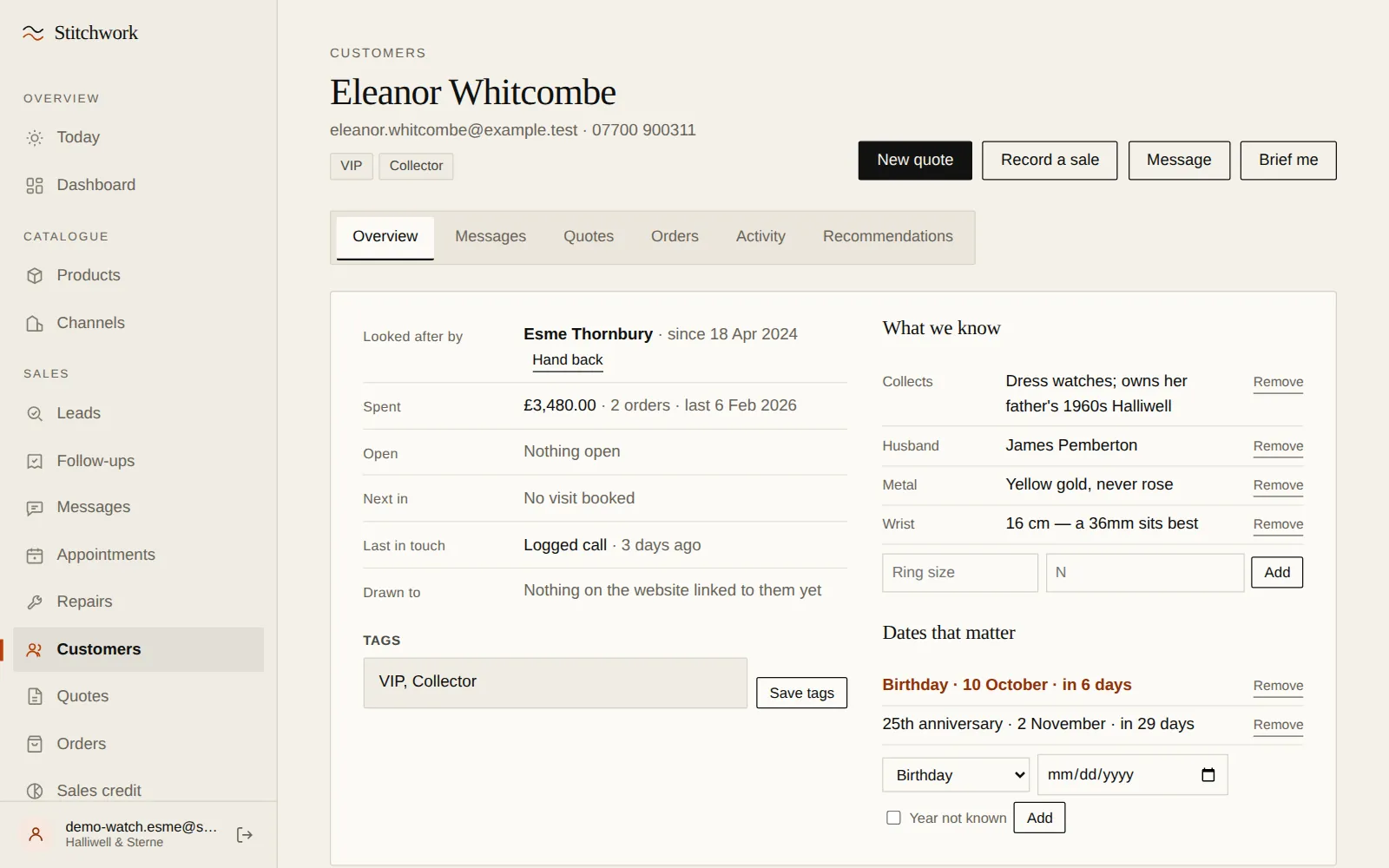
A client's record in Stitchwork: who looks after them, what they have spent, what the team knows about them and the dates that matter
A lookbook on the client's phone: the piece, a note from the associate, and Love it, Maybe and Not for me

What changes with Stitchwork

Most of what keeps your best clients loyal is written down nowhere.

It is in an associate's head, a notebook under the counter and a WhatsApp thread on somebody's own phone. The sale that slips is rarely lost on price. It is lost to a call nobody made.

The client book leaves with the associate.

Ring sizes, birthdays, the piece they have been saving for. When someone moves on, everything they knew goes with them.

Walk-ins leave no trace.

A name and a mobile on the back of a receipt. No email, so no system will take them — and the second visit starts from nothing.

Follow-ups live in somebody's memory.

The anniversary next month, the quote that runs out on Friday, the watch that has been ready to collect for nine days.

The conversation is on personal phones.

Messages nobody else can see, promises nobody else knows about, and no record of who agreed to hear from you.

The website and the shop floor never meet.

Three weeks of browsing and a basket left on Sunday night — then an associate who opens with “what brings you in today?”

The tools were built for mass email.

Campaign software counts opens and segments. Nothing counts whether the right person rang the right client at the right time.

One record of each client. A team that knows what to do next.

Everything below is the same record, seen from where each job is done — so whoever the client speaks to next picks up exactly where the last person left off. Rather click through it? Take the five-minute tour.

Who to contact today, and why.

Each associate opens Stitchwork to their own short list: the birthday next week, the quote that runs out on Friday, the client who came in on Saturday and has not heard back, the repair waiting to be collected. Every line says why — and what was said last time.

  • Birthdays, anniversaries and the dates that matter, in good time
  • Aftercare after a sale, and a call after a missed appointment
  • Quotes about to expire, repairs ready to collect
  • Closing one means writing what happened, so the next person knows

Nobody has to remember. Nobody rings twice.

Today in Stitchwork: an associate's calls in order, each with its reason — a client gone quiet, a birthday next week, a quote about to lapse — and the repairs waiting to be collected

Everything you know about them, on one page.

Who looks after them, what they have bought in the shop and online, their sizes and preferences, the dates that matter, their wishlist and every message both ways. Any colleague can pick up where the last one left off — and when someone moves on, the relationship stays with the business.

  • A walk-in with only a mobile number takes ten seconds to add
  • Marketing permissions per channel, with the date and how you know
  • One record however many addresses and numbers they use
  • Their whole file, exported in one click if they ask what you hold

The client book belongs to the shop, not to whoever kept it.

A client's marketing permissions in Stitchwork: agreed to email, text and post, each with the date, how they said so and who recorded it

Text, WhatsApp and email — from the record, not a personal phone.

Write to a client from their page and their reply lands back on it. Saved replies cover the messages you send every week. Before anything goes, Stitchwork says what they have agreed to hear about — so a thank-you stays a thank-you, and offers go only to the people who said yes.

  • One thread per client across email, SMS and WhatsApp
  • A reply nobody has answered goes on somebody's list
  • STOP is honoured the moment it arrives, and recorded
  • Nothing is sent until a person presses Send

The conversation stays with the client, where the whole team can see it.

A client's conversation in Stitchwork: their texts in one thread, and a reply the assistant drafted for a person to read and send

Send a personal edit. See what they love.

Pick a few pieces for one client, add a line about why, and send it as a page with your shop's name on it. They tap “Love it” or “Not for me”. You are told the moment they open it, and anything they love goes on their wishlist for next time.

  • Started from their wishlist, ready in a couple of minutes
  • Opens on any phone — no app, no login, nothing to install
  • Opens and reactions on their record, and an alert to whoever sent it
  • Sent by text, WhatsApp or email from their record

“Thought of you” — with the pictures, and an answer.

A lookbook built for one client in Stitchwork: the pieces chosen, a note on each, and what she thought of each one
A lookbook on the client's phone: the piece, a note from the associate, and Love it, Maybe and Not for me

Quote at the counter. Take the deposit before they leave.

Build the quote with the client in front of you and send it to their phone; it changes live as you do. They accept and pay the deposit by card in the room, or later from the link — and the balance follows when the piece is ready.

  • A deposit by percentage or a fixed amount, set once for the shop
  • Paid into your own Stripe account
  • No email? Text them the link or show them the QR code
  • Accepted, declined or paid — the team is told

The decision is made while they are still in the room.

A quote in Stitchwork: the total, the deposit to secure it, and the link that opens it on the client's phone
The quote on the client's phone: the piece with its picture, the deposit to secure it, and Accept

A proper ticket, a status link, and the “ready to collect” message already written.

Take in a watch for a service, a ring to resize or a jacket to alter: the condition on intake, the price, the date promised, and a printed ticket with a QR code. The client checks progress from their phone. When it is ready, one tap drafts the message — and if it is not collected, it is on somebody's list.

  • Received, in the workshop, ready, collected — with the history
  • Overdue jobs and uncollected pieces on the morning list
  • Collected and paid counts as a sale on their record
  • Resizes, cleans, engraving and valuations too

Aftercare that brings them back in, rather than a paper ticket in a drawer.

A watch in for a full service in Stitchwork: where it has got to, the condition on intake and the date promised
The repair's status page on the client's phone: ready to collect, the balance, and where to collect it

An assistant that does the remembering.

“Brief me on my two o'clock.” “Who should I ring this week?” The assistant answers from your own clients. It runs on Claude, sees only what the person asking can see, and drafts what they will send — it never sends anything itself, and it checks what each client has agreed to before it writes an offer.

  • A brief before a visit: what they own, what they are looking at, the open quote, the last conversation
  • Drafts for a person to edit and send
  • Follow-ups and notes it proposes wait for a person's yes
  • Connect your own Claude or another MCP client with one address

Five minutes of preparation in five seconds. The judgement stays human.

Ask Stitchwork briefing an associate before a client's visit, with a text drafted for them to send

Every visit online and every sale at the till, on the same person.

Connect Shopify and every order — online, or rung up on Shopify POS in the shop — lands on the client's record as it happens. One script tag on your website brings their browsing, baskets and searches too, so their first visit to the shop does not start from nothing.

  • Live Shopify and Shopify POS sync, with your history brought in
  • Other tills and platforms by CSV or the API
  • What clients agreed to in Shopify comes across with them
  • Your website's consent banner is followed, not replaced

No double entry, and no client who is two people.

Stitchwork's Shopify settings: connected, live updates on, and the orders, clients and products brought in
Start my free trial

Every feature is switched on from the first day — or see it on your own catalogue first.

Technology that stays out of the conversation.

People send. The assistant prepares.

Nothing reaches a client until a person has read it and pressed Send. The assistant briefs, finds and drafts; it cannot change or delete a thing.

Consent you can show.

Every yes and every no, by channel, with the date and how you know. A STOP reply or a spam complaint is recorded the moment it arrives.

The relationship belongs to the business.

Notes, messages and history live on the client's record — not on an associate's phone, and not in their head.

Priced for an independent.

From £400 a month for one showroom and three people; £850 for three showrooms and six. A larger group can agree terms with us.

Five ways it earns its place. Start with the one that costs you most.

All five run off the same customer record, so they switch on together — no extra modules, no second install.

Every “I need to think” gets a name and a day.

The customers worth calling become a short list with an owner and a date — routed to whoever raised their quote, at the store they raised it. If they buy before anyone rings, the follow-up takes itself off the list. When the sale lands, the credit goes to the people who earned it.

  • Each associate opens their own five, not a dashboard of two hundred — and closing one means writing what happened.
  • Opener 40%, closer 40%, anyone in between shares the rest. Frozen when the sale lands, and a manager can overrule it on the record.
  • Credit comes from sales, not activity, so it can't be farmed with notes and busywork.
How to follow up after a showroom visitGuide · 8 min read

Set the order value you want. Watch everything lean towards it.

Give Stitchwork a target average order and the products near it rise everywhere at once: the recommendations on your website, your category pages, and the list in your associate's hand when someone walks in.

  • Weight it your way — bestsellers, newness, what's popular, what's carted, what's on offer.
  • Feature a piece and it lifts, even for a fully personalised visitor. Your merchandising beats the algorithm.
  • No black box. Every product's score is broken down signal by signal, so you can see exactly why it ranks where it does.
How to raise your average order value without discountingGuide · 7 min read

Ask who's worth a call this morning.

Ask Stitchwork — the assistant on every page, built on Claude — answers from your own customers: the £4,000 basket left on Tuesday, the person circling the same armoire for three weeks, the good customer who's gone quiet. Then it puts them on the right colleague's list, with the reason attached. Prefer your own Claude, or another MCP client? Connect it with one URL.

  • “Brief me on the two o’clock.” What they're worth, what they've been looking at, the quote still open and what your team last wrote or sent them — in one answer.
  • It drafts, a person sends. By email, text or WhatsApp, from the customer's record — and their reply lands back on it. Nothing goes until somebody presses Send.
  • It sees what the person asking can see, and nothing more. Notes and follow-ups it suggests wait for your yes; it can never change or delete a thing.
Using AI with customer data: give it a door, not an exportGuide · 7 min read

See which campaigns turn into sales — including the ones that close in the showroom.

Every campaign click lands on the customer's record, next to their store visits, quotes and orders. The attribution report splits each sale's credit across the campaigns that came before it, so you can see what's actually paying its way.

  • Five attribution models, switchable in one click. A campaign that leads under all five is one to back.
  • Every sale accounted for, including the walk-ins and repeat customers no campaign touched.
  • By source, medium or campaign, for any window you choose.
How to attribute showroom sales to your website and your adsGuide · 8 min read

Speak up while they're still deciding. Know whether it worked.

Show one line on your own site to a visitor whose browsing matched a rule you wrote — the person who's been round the same four beds for twenty minutes. Offer a callback, and it lands on a colleague's list with the reason attached.

  • A tenth of matching visitors see nothing, so the lift in the report is lift the message actually earned.
  • Thresholds learned from your own buyers — what they did before they bought — instead of a guess.
  • Rides on the same tag and your existing consent banner. No popup builder, no second script.
Holdout groups: how to tell whether a website message workedGuide · 7 min read
Start my free trial

All five switch on together the day you sign up — or see them running on your own catalogue first.

It won't break your website. Or your consent banner.

One script that can't throw into your page.

It guards every browser call that can fail and swallows its own errors. A test loads it into a deliberately hostile browser on every commit.

Your consent banner, not a second one.

It follows Cookiebot, Shopify Customer Privacy and any IAB TCF v2.2 platform — OneTrust, Usercentrics, Didomi. Global Privacy Control always wins.

IP addresses are never stored.

Only a salted hash, so a visit can be recognised without the address ever being written down. First-party cookies, on your own domain.

Your data is walled off at the database.

Row-level security on every table. And a lapsed bill never stops a customer paying a quote, or your site tracking.

Want the detail? The technical documentation is open — no form, no email gate. Send it to your developer.

Priced by the size of the business, in the open. Seven days free to see if it earns it.

Start without talking to anyone. The trial runs on Collection with everything switched on, so you see what each plan includes before you choose one in Settings. Every plan includes order-value ranking, attribution and nudges. Pay yearly and two months are free, and the launch package is included.

Independent

£400/month

One showroom, and three people in it — you and two colleagues.

  • £75 a month for each further colleague who talks to customers
  • 2,000 assistant credits a month included
  • Website browsing on every client record, quotes, deposits, follow-ups and the morning list
  • The optimisation tools included: order-value ranking, attribution, and nudges measured against a held-back control group
  • 0.5% on quote payments taken through Stitchwork, capped at £15 a payment
Start my free trial

Collection

£850/month

Three showrooms and six people. £200 a month for each further showroom.

  • £75 a month for each further colleague — two showrooms and eight people come to £1,000
  • 6,000 assistant credits a month included
  • Everything in Independent, across every showroom
  • 0.3% on quote payments taken through Stitchwork, capped at £15 a payment
Start my free trial

The seven-day trial runs on this plan, every feature on, no card.

Group · from

£2,500/month

Ten showrooms or more, the team you have, and terms agreed with us.

  • People, showrooms and assistant credits by agreement
  • Payments from 0.2%, capped at £15 a payment
  • Invoicing in your own currency, or a contract through AWS Marketplace
  • Everything in Collection
Book a demo

The arithmetic.

At a £4,000 average order, one sale a month that would otherwise have walked out of the door is worth ten times what Independent costs, and nearly five times Collection. Put in your own average order: the question is not whether software is worth £400 a month, it is whether the morning list finds you one sale a month you would have missed.

Founding shops.

The first ten shops to join get 30% off their first twelve months, in return for a case study and a reference call once it is working for them. Open until 31 March 2027 — after that, the prices above. Ask about founding terms.

On every plan.

  • £15 a month for each AI connection — an MCP seat for Claude or your own agent
  • More assistant credits in packs — 2,000 for £20, 5,000 for £50, 10,000 for £100 — that never expire
  • The launch package — £1,250, once. Every new shop starts with it: we load your catalogue, put the tag on your website, bring in your order history, and connect Twilio and WhatsApp. Shops set up properly stay
  • Pay yearly: ten months' price for twelve, with the launch package included

Payments go into your own Stripe account.

Deposits and balances, paid on the quote's page or on a Stripe card reader at the counter, land in your own Stripe account, with Stripe's card fees charged there as usual. Our fee is on top and capped at £15 a payment — £10 on a £2,000 deposit on Independent — and if you refund a payment, our fee goes back with it. Taking it by bank transfer or your own terminal instead? Mark it paid; there is no fee.

Texting runs on your own account.

SMS and WhatsApp go through your own Twilio number, billed by Twilio at their rates — usually a few pence a text. We add no margin. Email from the customer's record is included.

The questions you'll ask before you start.

"We already run Shopify. What has to change?"
Nothing your customers would notice. Connect your store and every order — online, or rung up on Shopify POS in the shop — arrives on the client's record as it happens, with your history brought in. One script tag adds their browsing, and checkout stays exactly where it is. Magento, WooCommerce, other tills and bespoke sites come in by CSV or the API. It's live in an afternoon.
"Will our associates actually use it?"
It runs on the iPad they already carry and opens to their own short list for the day — who to contact and why — so the first thing it does is save them work. The opening ten minutes of every conversation are already done, and the credit for the sale lands with them, which is what gets a tool opened every morning.
"How does a walk-in get onto the record?"
Ask their name and mobile number — that is a client, added in ten seconds, and their next visit starts with what they told you. If they give an email later, booking online or at the till, it joins the same record rather than starting a second one. A QR code or an NFC tag in the shop links weeks of their website browsing too.
"Can we run it across several showrooms?"
Yes. Every showroom, region, dealer and pop-up is its own channel, with its own staff, currency and monthly numbers. A customer who visits two of them is still one record — including who they spoke to at each.
"Is our customer data safe?"
Stitchwork follows the consent banner you already run, honours Global Privacy Control, never stores a visitor's IP address, and isolates your data at the database. The built-in assistant and anyone you connect an AI for see only what that person already sees — and either can be switched off in one click. If a client asks what you hold, their whole file downloads in one click.
"Do we need clients' permission to message them?"
Not for messages about their own order, appointment or repair. For news, new pieces and offers they need to have agreed — so Stitchwork records who did, on which channel, when and how you know; records a STOP reply or a spam complaint the moment it arrives; and tells whoever is writing before an offer goes to someone who has not said yes.
"Can it handle repairs and servicing?"
Yes. A watch service, a ring resize, an alteration or a re-upholstery gets a reference, the condition on intake, a price, a promised date and a printed ticket with a QR code. The client checks progress from their phone, the morning list shows what is overdue or waiting to be collected, and a collected job counts as a sale on their record.
"What does it cost?"
Independent is £400 a month for one showroom and three people — you and two colleagues — with 2,000 assistant credits a month. Collection is £850 a month for three showrooms and six people, with 6,000 credits a month. Both include order-value ranking, attribution and nudges. Each further colleague is £75 a month and each AI connection £15, so two showrooms and eight people come to £1,000 a month. Every new shop starts with the £1,250 launch package; pay yearly and it is included, with two months free. Quote payments taken through Stitchwork carry a small fee, capped at £15. Seven days free first, no card. A group of ten showrooms or more agrees terms with us instead. The full price, in the open.
"Can we try it without talking to anyone?"
Yes. Sign up, name your workspace and you're in. A checklist on your dashboard walks you through the tag, your catalogue and a year of orders, and choosing the plan is a button in Settings when you're ready. If you'd rather see it on your own catalogue first, book the demo.
What the associate sees the moment the customer walks in.

See it working on your own catalogue.

Thirty minutes with the people who built it. We'll load your catalogue, walk one real customer journey across your website and your floor, and show you exactly where sales are slipping between them — and what your team would see instead.

  1. Tell us about your business

    Six quick questions, so the demo is about your catalogue from the first minute.

  2. See it on your catalogue

    A 30-minute walkthrough. A person replies to set it up, usually the same day.

  3. Run it for seven days

    Every feature switched on, no card. Then the published plan — or, for a larger group, terms set for your business.

Book your demo

Takes about a minute. It goes straight to the team that built Stitchwork.

Just a quick question? Send us a message.